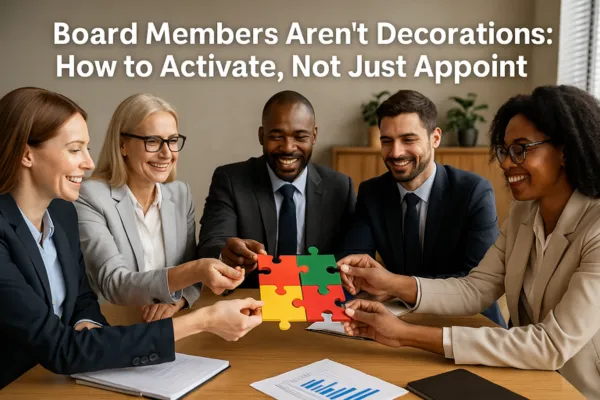
Board Members Aren’t Decorations: How to Activate, Not Just Appoint
Board Members Aren’t Decorations: How to Activate, Not Just Appoint
By Willie Finklin, CFRE, The Grant GOAT
Every nonprofit needs a board, but not every board is effective. Too often, founders assemble a group of people to “fill seats” without understanding that a board is not a formality, it's a leadership body.
A passive board might look good on paper, but it won’t move your mission forward. If your board members only show up for annual meetings, take nice photos, or lend their names for credibility, you have a problem.
Your board should be your nonprofit’s engine, not its ornament. Let’s explore how to build and activate a board that leads with purpose.
Start With Purpose, Not People
Many founders recruit friends and family first because it feels safe. But building your board around convenience instead of competence creates long-term frustration.
Every board member should bring a specific purpose, expertise, networks, or resources that strengthen the organization.
Before inviting anyone to join, define what your board needs. Do you need a finance expert, a legal advisor, a community connector, or a strategist? Once you know the gaps, recruit intentionally.
Your goal is not just to fill chairs, but to build capacity.
Clarify Roles and Expectations
Most nonprofit boards underperform because expectations were never clear. If board members don’t know what’s expected, they will default to doing the bare minimum.
Set clear standards from the start. Provide a board handbook, outline responsibilities, and establish accountability systems.
At minimum, every board member should:
Attend meetings regularly
Participate in strategic planning
Contribute financially or through fundraising
Serve as ambassadors for the mission
Accountability doesn’t scare good board members, it attracts them.
Train Your Board to Lead, Not Just Listen
You cannot expect your board to perform well if they have never been trained. Even passionate members need direction.
Offer onboarding sessions that explain your nonprofit’s structure, programs, and financial responsibilities. Provide ongoing development through workshops or board retreats.
When your board understands its role, meetings become productive and decisions become strategic.
Create a Culture of Engagement
Engaged boards don’t just meet, they move. They ask questions, challenge ideas, and celebrate wins.
Build a culture where participation is expected and valued. Keep communication open between meetings. Share updates, wins, and challenges regularly so members stay connected to the mission.
Also, make space for appreciation. When board members feel valued, they invest deeper in the organization’s success.
Use Committees Strategically
If your board meetings feel overloaded, it’s likely because everything happens in one room. Committees create focus and distribute the workload.
Establish small groups for areas like finance, fundraising, or governance. This allows members to use their strengths effectively and keeps the organization moving between meetings.
Committees are where strategy becomes action.
Don’t Be Afraid to Rebuild
Sometimes you outgrow your board. That’s not failure, it's evolution.
If your organization’s direction has changed or if certain members are no longer engaged, it’s okay to transition them out respectfully.
Regularly assess your board’s effectiveness. Ask: “Do we have the right people in the right roles?” If not, make adjustments. A stagnant board limits a growing mission.
Final Thoughts: A Strong Board Multiplies Impact
An active board is one of the greatest assets a nonprofit can have. They bring perspective, accountability, and credibility. But that only happens when you treat them as leaders, not figureheads.
When you recruit with purpose, set clear expectations, and foster engagement, your board becomes a force multiplier.
At PM3 University, we help founders build high-performing boards that not only believe in the mission but also help drive it forward. Because your board isn’t just part of your organization it’s the backbone of your success.