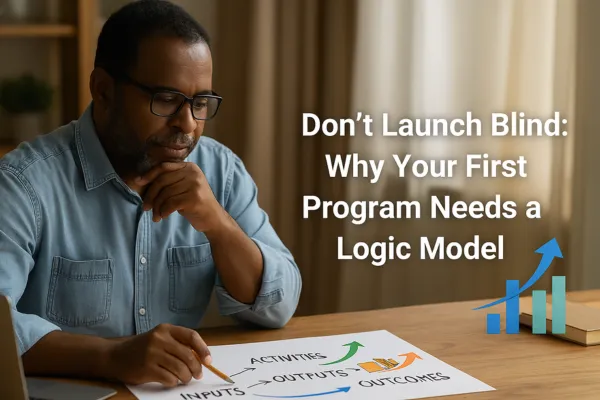
Don’t Launch Blind: Why Your First Program Needs a Logic Model
Don’t Launch Blind: Why Your First Program Needs a Logic Model
By Willie Finklin, CFRE, The Grant GOAT
Many new nonprofit founders are eager to jump straight into launching their first program. The passion is there, the need is clear, and the desire to serve is strong. But too often, they skip one critical step that determines whether their efforts succeed or stall: creating a logic model.
A logic model is not just a chart or a grant requirement. It is a roadmap that helps you design your program with intention and clarity. Without it, you are essentially launching blind.
Let’s explore why every new nonprofit should start with a logic model and how it can transform your programs from ideas into measurable impact.
A Logic Model Turns Vision Into a Plan
You may have a strong vision for change, but a logic model helps you connect that vision to action. It organizes your ideas into a clear sequence that shows how your activities lead to results.
A basic logic model includes:
Inputs: The resources you will use, such as staff, volunteers, or funding.
Activities: What you will do with those resources.
Outputs: The tangible results of your activities, such as workshops held or clients served.
Outcomes: The changes or benefits your participants experience.
This model forces you to think through how each step leads to the next, ensuring that your program has a logical foundation before you spend a dollar or launch a service.
It Keeps You Focused and Aligned
New nonprofits often try to do too much too soon. A logic model helps narrow your focus so you can concentrate on what truly moves your mission forward.
It also aligns your board, staff, and volunteers. Everyone sees the same picture of how the program works and what success looks like. That shared understanding prevents confusion and keeps your team pulling in the same direction.
When everyone understands the purpose behind each activity, your organization becomes more strategic and effective.
Funders Expect It
Most experienced funders will ask for a logic model or program framework before they consider your proposal. Why? Because they want proof that your organization can plan, execute, and evaluate a program with clarity.
A logic model shows funders that you understand how to measure results and adjust as needed. It also makes your proposals stronger because your story becomes more organized, evidence-based, and credible.
Think of it as your program’s blueprint for funders, a signal that you know what you are doing.
It Helps You Measure What Matters
If you launch a program without defining what success looks like, you will never know whether it worked. A logic model gives you specific, measurable outcomes that guide how you collect data and report results.
When you track the right indicators, you can make informed decisions, demonstrate impact, and improve performance over time.
The ability to measure and prove outcomes is what separates successful nonprofits from struggling ones.
It Prevents Mission Drift
Without a logic model, it is easy to get pulled in different directions by new opportunities or funder requests. You start adding programs or activities that sound good but do not align with your mission.
Your logic model keeps you anchored. It reminds you what your organization is built to do and why. When new opportunities come up, you can evaluate whether they fit your established plan or distract from it.
Mission alignment is not just about discipline, it is about longevity.
It Builds a Stronger Case for Funding and Support
Funders, partners, and community stakeholders want to support organizations that think strategically. A well-designed logic model shows that you have done the work to understand the problem, design a solution, and plan for results.
It turns your program from a concept into a credible, fundable strategy.
When you can clearly articulate how your inputs lead to impact, you build confidence with everyone from grantmakers to volunteers.
Final Thoughts: Design Before You Deliver
Launching a program without a logic model is like building a house without a blueprint. You might end up with walls and a roof, but nothing will fit together the way it should.
A logic model helps you see the big picture before you take your first step. It ensures your resources, efforts, and goals are connected in a way that produces real, lasting impact.
At PM3 University, we teach nonprofit founders how to build programs that start strong, stay focused, and deliver measurable results. Because when you plan with purpose, you lead with confidence.