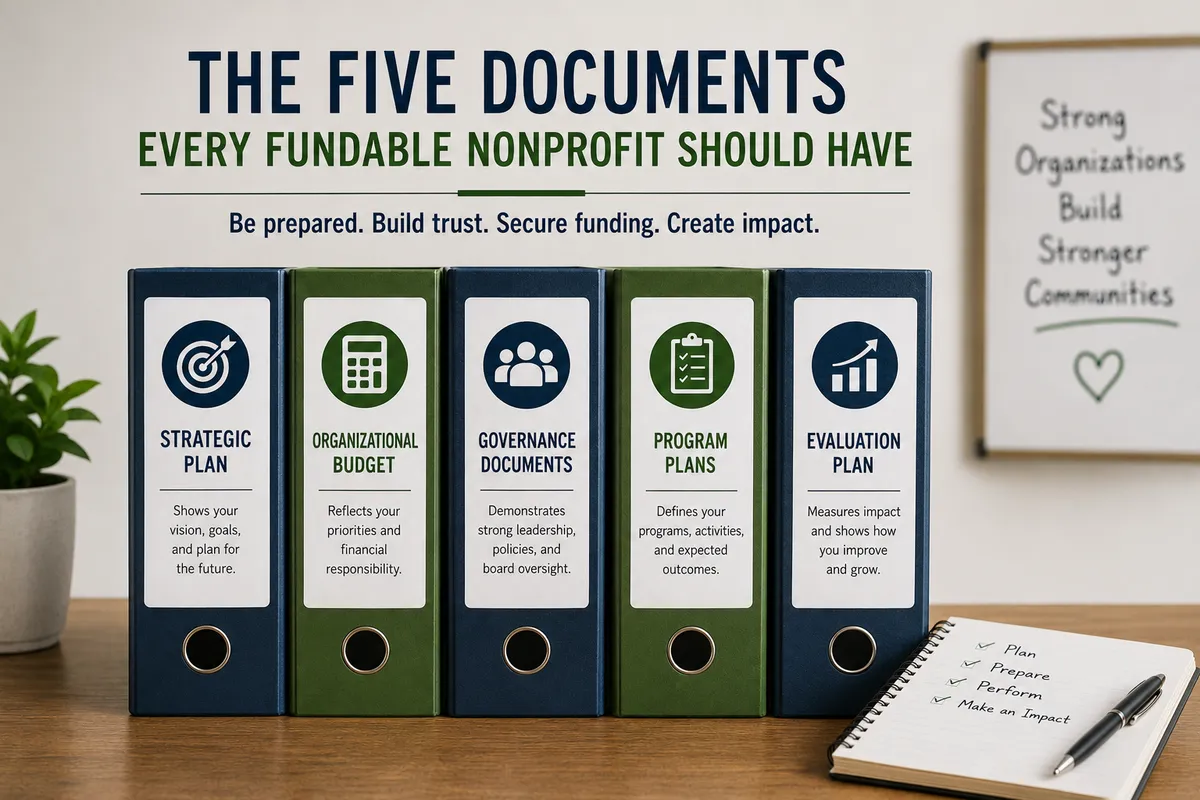
The Five Documents Every Fundable Nonprofit Should Have
The Five Documents Every Fundable Nonprofit Should Have
By Willie Finklin, CFRE, The Grant GOAT
One of the biggest misconceptions in the nonprofit sector is that grant funding begins with writing a proposal.
It doesn't.
Long before you start typing the first sentence of a grant application, your organization should already have the documents that demonstrate you're prepared to manage funding responsibly. Unfortunately, many nonprofits wait until they find the perfect grant opportunity before scrambling to pull together policies, financial records, and organizational information. That approach creates unnecessary stress, rushed decisions, and applications that often fall short of a funder's expectations.
Think about it from a grantmaker's perspective. They're investing thousands, sometimes millions, of dollars into organizations they believe can create meaningful change. Before they approve that investment, they want confidence that your nonprofit is organized, accountable, and capable of delivering the results you've promised.
While every funder has different application requirements, there are a handful of documents that almost every grantmaker expects a nonprofit to have. These documents don't guarantee funding, but not having them can quickly raise concerns about your organization's readiness.
If your nonprofit wants to compete for grants, these are five documents you should have long before you submit your next proposal.
A Strategic Plan That Shows Where You're Going
A strategic plan is much more than a document that sits on a shelf collecting dust. It tells funders that your organization has thought beyond today's challenges and is planning intentionally for the future.
Many nonprofits operate from one opportunity to the next. They respond to immediate needs, apply for grants as they appear, and make decisions based on available funding rather than long-term priorities. While that approach may keep the organization moving, it rarely produces sustainable growth.
A strategic plan demonstrates that your leadership has identified clear goals, established priorities, and developed a roadmap for achieving them. It helps funders understand how the project they're being asked to support fits into the larger vision of the organization.
More importantly, it keeps your nonprofit focused. Instead of allowing funding opportunities to dictate your direction, your strategic plan helps determine which opportunities actually align with your mission.
A Realistic Organizational Budget
I've said it before, and it's worth repeating.
Your budget is one of the most important documents your nonprofit will ever produce.
A budget tells the financial story of your organization. It reflects your priorities, your planning, and your ability to manage resources responsibly. Funders often review budgets before reading the proposal narrative because numbers provide an immediate snapshot of how an organization operates.
An effective budget should be accurate, realistic, and aligned with your organization's activities. It should account for personnel, program expenses, administrative costs, fundraising, and other operational needs. More importantly, it should demonstrate that leadership understands the true cost of delivering services.
Budgets built on assumptions or guesswork are easy to recognize. Grant reviewers compare proposals from hundreds of organizations every year, and unrealistic financial projections quickly raise questions about an organization's preparedness.
A well-developed budget doesn't simply support your proposal.
It strengthens your credibility.
Board Policies and Governance Documents
Strong governance is one of the clearest indicators of a healthy nonprofit.
Funders want to know that your organization is guided by a board that understands its responsibilities and provides meaningful oversight. That confidence comes from more than simply having board members listed on your website.
It comes from documented governance practices.
Every nonprofit should have current bylaws, conflict-of-interest policies, board member responsibilities, and meeting minutes that demonstrate active governance. These documents show that important decisions are being made thoughtfully and that accountability exists at every level of the organization.
Healthy governance protects the nonprofit, its leadership, and the communities it serves. It also reassures funders that their investment will be managed responsibly and ethically.
Your board isn't just a legal requirement.
It's one of your organization's greatest assets.
Program Plans That Clearly Define Your Work
One of the questions funders ask themselves is surprisingly simple.
"What exactly does this organization do?"
Many nonprofits can describe their mission beautifully, but struggle to explain how their programs actually work. That's where program documentation becomes essential.
Every major program should have clearly defined goals, target populations, activities, timelines, expected outcomes, and evaluation methods. This information helps funders understand not only what you plan to do, but how you intend to accomplish it.
Well-developed program plans also improve consistency within your organization. Staff, volunteers, board members, and community partners all operate from the same understanding of what success looks like.
Strong programs don't happen because people work hard.
They happen because people work from a well-designed plan.
An Evaluation Plan That Measures Your Impact
Perhaps one of the most overlooked documents in many nonprofits is an evaluation plan.
Far too often, organizations focus on counting activities instead of measuring outcomes. They report how many workshops they hosted, how many meals they served, or how many volunteers participated, but they struggle to explain what actually changed because of their work.
Funders want more than activity reports.
They want evidence of impact.
An evaluation plan identifies what success looks like, how it will be measured, who will collect the data, and how the organization will use that information to improve future programs. It demonstrates that your nonprofit values accountability and is committed to learning from its work.
You don't need a complicated evaluation system to begin measuring impact.
You simply need a thoughtful plan that answers one important question.
How do we know we're making a difference?
Organizations that can answer that question with confidence are much more attractive to funders.
Final Thoughts: Documents Don't Win Grants, But They Build Confidence
Having these documents won't automatically guarantee your nonprofit receives funding.
What they do is demonstrate something just as important.
Preparation.
Every strategic plan, budget, governance policy, program plan, and evaluation framework tells funders that your organization takes its responsibilities seriously. They communicate that your nonprofit isn't simply driven by passion, but by thoughtful planning, accountability, and a commitment to continuous improvement.
If you're preparing to pursue grant funding, resist the temptation to focus only on the proposal itself. Spend time strengthening the foundation behind the proposal. The stronger your organization becomes, the stronger every future grant application will be.
At PM3 University, we believe grant readiness starts long before the application is written. It begins with building organizations that are prepared, organized, and equipped to create lasting impact. When your nonprofit has the right foundation in place, every proposal becomes a reflection of the work you've already done to earn a funder's confidence.
Because successful grant writing isn't just about telling a compelling story.
It's about proving your organization is ready to deliver it.