Why Every Nonprofit Needs a Theory of Change
Why Every Nonprofit Needs a Theory of Change
By Willie Finklin, CFRE, The Grant GOAT
If I asked you to explain how your nonprofit changes lives, what would you say?
Most nonprofit leaders would immediately begin talking about their programs. They'd describe the services they provide, the people they serve, and the difference they're trying to make in their communities.
Those are all important pieces of the story.
But here's a deeper question.
How do you know your programs are actually creating the change you hope to see?
That's where many organizations struggle.
I've worked with nonprofits that were incredibly busy. They hosted events, served hundreds of clients, recruited volunteers, and delivered valuable programs every week. Yet when it came time to explain how those activities were creating long-term impact, the answer wasn't always clear.
Being busy isn't the same as being effective.
One of the best tools a nonprofit can use to connect its mission, programs, and outcomes is something called a Theory of Change. While the name may sound academic, the concept is surprisingly practical. It helps organizations think intentionally about how their work creates meaningful, measurable change.
If you've never developed a Theory of Change, or if you've heard the term but weren't quite sure what it meant, this article is for you.
1. A Theory of Change Explains More Than What You Do
Many nonprofits are excellent at describing their programs.
"We provide tutoring."
"We offer job training."
"We mentor youth."
"We distribute food."
Those descriptions explain what the organization does, but they don't explain why those activities should produce the outcomes you're expecting.
A Theory of Change fills in that missing connection.
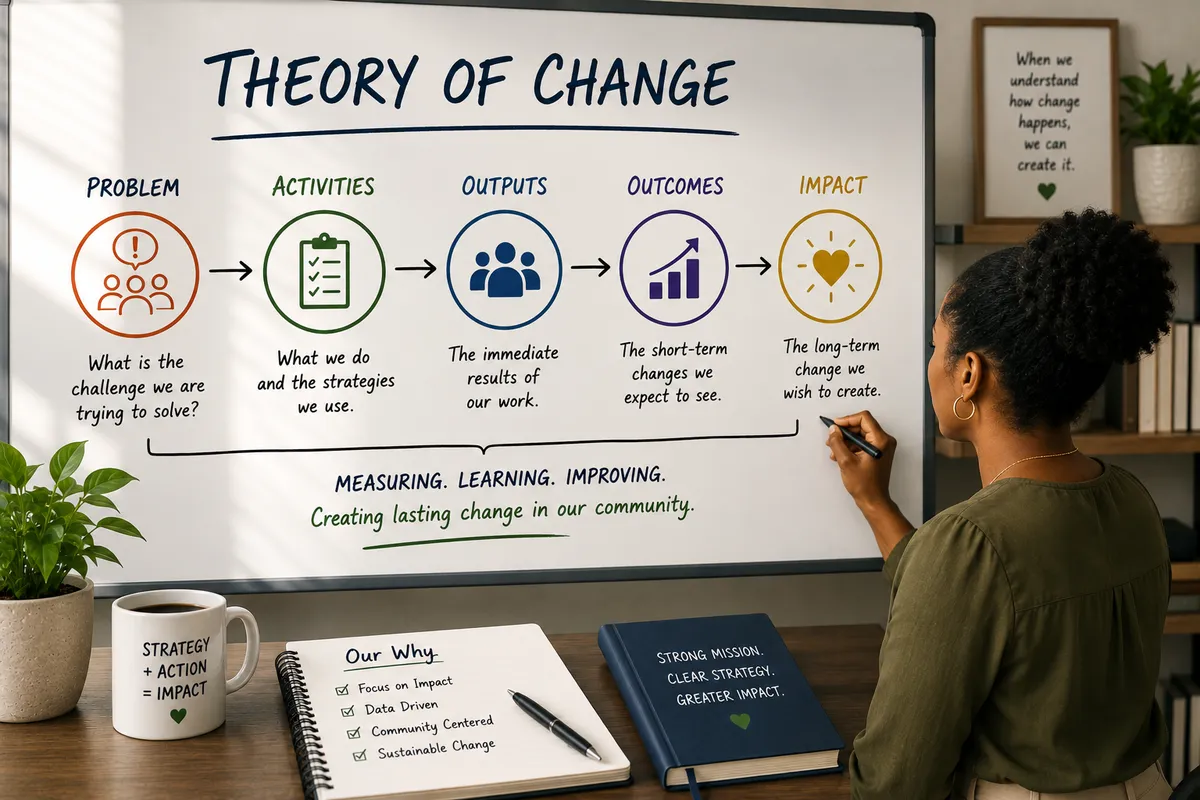
It identifies the problem you're trying to solve, the activities you'll implement, the short-term results you expect to see, and the long-term impact your organization hopes to achieve. In other words, it tells the complete story of how your work creates change instead of simply listing the services you provide.
When everyone within the organization understands that connection, decisions become more intentional because every program supports a clearly defined purpose.
2. It Keeps Your Organization Focused on the Mission
As nonprofits grow, opportunities begin appearing from every direction. A new grant becomes available. A community partner suggests another program. A donor expresses interest in funding a different initiative.
While these opportunities may be exciting, they also have the potential to pull an organization away from its core mission.
A Theory of Change acts like a compass.
It helps leadership evaluate new opportunities by asking an important question: Will this activity help create the change we've committed to achieving?
If the answer is yes, the opportunity may deserve serious consideration. If the answer is no, it may be a sign that the organization is drifting away from its purpose.
Staying focused doesn't mean saying no to growth.
It means saying yes to the right growth.
3. Funders Want to Understand Your Logic
One of the biggest mistakes nonprofit leaders make is assuming funders only want to know what programs they'll be supporting.
In reality, funders want to understand why those programs should work.
When reviewing grant proposals, they're looking for evidence that your organization has carefully considered how its activities will lead to meaningful outcomes. They want confidence that your approach is based on thoughtful planning rather than assumptions.
A well-developed Theory of Change demonstrates exactly that.
It shows you've identified the problem, understand the underlying causes, selected appropriate strategies, and established realistic expectations for measuring success. This level of planning helps funders feel more confident that their investment will produce measurable community impact.
Grant proposals become much stronger when they're supported by a clear and logical framework for change.
4. It Makes Measuring Impact Much Easier
One question every nonprofit should ask is this:
"How will we know if we've been successful?"
Without a Theory of Change, that question can be surprisingly difficult to answer.
Organizations often end up measuring activities instead of outcomes. They count how many people attended a workshop, received food, or participated in a program, but they struggle to explain whether those services actually improved someone's life.
A Theory of Change helps define what success looks like before the work even begins.
If your goal is to improve literacy, what evidence would demonstrate progress?
If your mission is to reduce homelessness, what outcomes should you expect to see?
If you're mentoring young people, how will you measure growth beyond attendance?
Answering these questions early allows your organization to collect meaningful data instead of scrambling to find evidence after the program is over.
5. It Creates Alignment Across the Organization
One of the greatest benefits of developing a Theory of Change is that it creates a shared understanding throughout the organization.
Board members understand the long-term vision.
Staff understand how their daily responsibilities contribute to that vision.
Volunteers understand why their work matters.
Donors gain confidence because they can clearly see how their support contributes to measurable outcomes.
When everyone is working toward the same clearly defined goals, communication improves, decision-making becomes easier, and the organization operates with greater consistency.
Alignment isn't something that happens by chance.
It's something leaders intentionally create.
6. A Theory of Change Should Continue to Evolve
Some organizations make the mistake of treating their Theory of Change as a one-time exercise.
They develop it, place it in a binder, and rarely look at it again.
That's not how it's meant to work.
Communities change.
Needs evolve.
Research advances.
Organizations grow.
Your Theory of Change should evolve as your understanding grows.
Review it regularly. Evaluate whether your assumptions still hold true. Use program data, participant feedback, and evaluation results to strengthen your approach over time. Continuous learning is one of the characteristics that separates strong organizations from stagnant ones.
Your Theory of Change isn't simply a planning document.
It's a tool for continuous improvement.
Final Thoughts: Don't Just Deliver Programs, Create Lasting Change
Every nonprofit wants to make a difference.
The question is whether your organization has intentionally defined how that difference happens.
A Theory of Change helps connect your mission to your programs, your programs to measurable outcomes, and your outcomes to lasting community impact. It gives your board confidence, strengthens grant proposals, improves strategic planning, and helps your organization stay focused on the work that matters most.
Most importantly, it reminds everyone involved that success isn't measured by how busy you are.
It's measured by the lives you change.
At PM3 University, we believe strong nonprofits don't just work hard, they work intentionally. We help nonprofit leaders develop the strategies, systems, and organizational capacity needed to transform great ideas into measurable, sustainable impact.
Because when you understand how change happens, you're far more likely to create it.