Why Most Nonprofits Stay Small (And How Yours Doesn't Have To)
Why Most Nonprofits Stay Small (And How Yours Doesn't Have To)
By Willie Finklin, CFRE, The Grant GOAT
Every nonprofit starts with a vision.
For some, it's feeding hungry families. For others, it's mentoring youth, providing housing, supporting veterans, advocating for social justice, or improving access to education. Whatever the mission may be, every founder hopes their organization will grow into something that creates lasting impact.
Yet the reality is that many nonprofits never move beyond being small organizations.
There's nothing wrong with being a small nonprofit. Some organizations intentionally remain small because it allows them to provide highly personalized services within their communities. The problem arises when an organization wants to grow but can't seem to move beyond the same challenges year after year.
I've met nonprofit leaders who have spent years working tirelessly, applying for grants, organizing fundraisers, and serving their communities, yet they feel like they're running in place. They aren't lacking passion, and they certainly aren't lacking commitment.
What they're often lacking is a strategy for growth.
Growing a nonprofit isn't simply about raising more money. It's about building an organization that is prepared to handle greater responsibility, larger opportunities, and increased community impact.
If your organization has been stuck in the same place, let's talk about some of the reasons why that happens and, more importantly, what you can do about it.
You're Working in the Organization More Than You're Working on the Organization
One of the biggest challenges nonprofit leaders face is finding time to think strategically. Every day brings another email to answer, another meeting to attend, another program to coordinate, or another problem to solve. Before long, the urgent begins to overshadow the important.
Many founders spend so much time keeping the organization running that they rarely step back to evaluate where it's going. Strategic planning gets postponed. Policies remain unfinished. Board development takes a back seat. Long-term fundraising plans are replaced by short-term fundraising events.
Working in the organization keeps today's programs moving.
Working on the organization prepares it for tomorrow.
Successful nonprofit leaders intentionally create time to evaluate their organization's direction, identify opportunities for improvement, and make decisions that strengthen the nonprofit for years to come. Growth doesn't happen by accident. It happens when leaders make time to build the organization, not just manage it.
You're Depending on One Source of Funding
One of the fastest ways to limit your organization's growth is relying too heavily on a single funding source.
Some nonprofits depend almost entirely on grants. Others rely on one annual fundraiser, one major donor, or one government contract. While any of these funding sources can be valuable, they become risky when they're the only source supporting the organization.
Healthy nonprofits diversify their revenue.
They build relationships with individual donors, pursue grants strategically, develop corporate partnerships, host fundraising events, and explore earned income opportunities when appropriate. This balanced approach creates greater financial stability and allows organizations to continue serving their communities even when one funding source changes.
Diversified funding isn't just about reducing risk.
It's about creating flexibility and positioning your nonprofit for sustainable growth.
Your Board Isn't Helping You Grow
A nonprofit board should be much more than a legal requirement.
An effective board provides governance, strategic guidance, fundraising support, community connections, and professional expertise. They challenge leadership to think bigger while helping the organization remain accountable to its mission.
Unfortunately, many boards become passive. Meetings focus on reviewing reports instead of discussing strategy. Members attend regularly but contribute very little outside the boardroom. The executive director ends up carrying responsibilities that should be shared across the leadership team.
Growing nonprofits understand that building a strong board is an ongoing process.
They recruit individuals with diverse skills, provide meaningful orientation and training, establish clear expectations, and create opportunities for board members to actively support fundraising, advocacy, and organizational development.
A fully engaged board doesn't simply oversee the organization.
It helps move the organization forward.
You're Measuring Success by Activity Instead of Impact
Being busy can feel productive, but activity alone doesn't guarantee progress.
Many nonprofits proudly report the number of events they hosted, meetings they attended, or volunteers they recruited. While those accomplishments deserve recognition, they don't always demonstrate the true impact of the organization's work.
Funders, donors, and community partners increasingly want to understand outcomes.
How many lives were improved?
What measurable changes occurred because of your programs?
How has your organization addressed the problem you were created to solve?
Organizations that consistently collect and evaluate data are better equipped to improve programs, communicate their value, and secure future funding. Measuring impact also helps leadership make informed decisions about where to invest resources and which programs produce the greatest results.
Growth becomes much easier when your decisions are guided by evidence instead of assumptions.
You're Waiting for Funding Before Building Capacity
It's common to hear nonprofit leaders say, "Once we receive a large grant, we'll hire staff, improve our systems, and strengthen our infrastructure."
While that sounds reasonable, it often creates a cycle that's difficult to escape.
Funders are looking for organizations that already demonstrate strong leadership, sound financial management, and operational readiness. Waiting for funding before investing in capacity can actually make it harder to secure the funding you're hoping for.
Capacity building doesn't always require a significant financial investment. It often begins with strengthening board governance, documenting procedures, improving financial practices, developing strategic plans, and investing in leadership development.
When organizations intentionally strengthen their foundation, they become much more attractive to funders because they've demonstrated that they're prepared to manage growth responsibly.
You're Thinking Like a Startup Instead of Building for Sustainability
Starting a nonprofit and sustaining a nonprofit require two very different mindsets.
In the early days, it's natural to focus on survival. Every donation matters, every volunteer is essential, and every opportunity feels urgent. That mindset helps organizations get off the ground.
Eventually, however, leaders must begin thinking beyond survival.
Sustainable organizations invest in succession planning, leadership development, financial reserves, strategic partnerships, and long-term planning. They recognize that lasting impact isn't created by constantly reacting to today's challenges but by preparing for tomorrow's opportunities.
Growth isn't simply about becoming larger.
It's about becoming stronger.
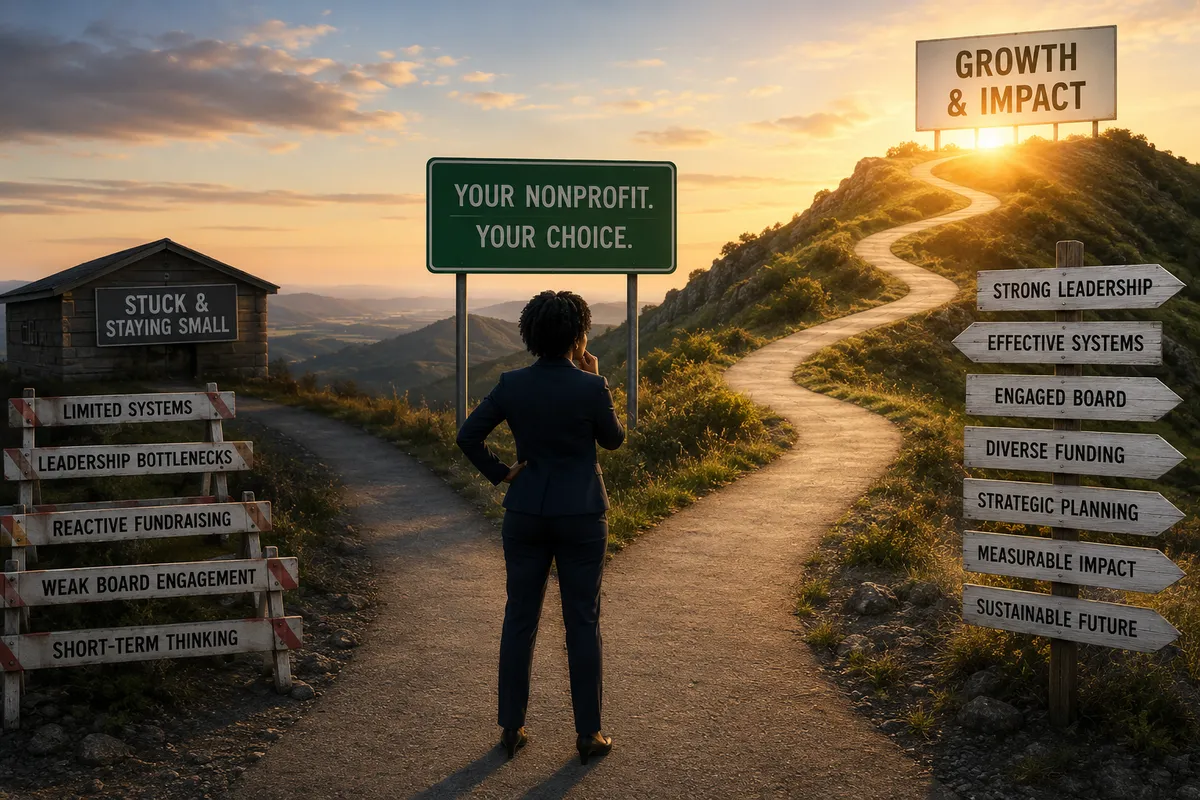
Final Thoughts: Growth Is a Decision Before It Becomes a Destination
Every nonprofit has the potential to create meaningful change, but growth doesn't happen because we hope for it.
It happens because leaders intentionally build organizations that are prepared for greater opportunities.
If your nonprofit has remained the same size for several years, don't assume your mission has reached its limit. Instead, ask yourself whether your organization has reached the limits of its current systems, leadership, or strategy.
Sometimes the greatest barrier to growth isn't outside the organization.
It's inside it.
The encouraging news is that every one of those barriers can be addressed. Stronger leadership can be developed. Better systems can be implemented. Boards can become more engaged. Funding strategies can become more diversified. Organizational capacity can be strengthened.
At PM3 University, we believe every nonprofit has the ability to grow beyond its current limitations. By investing in leadership, capacity building, and long-term sustainability, organizations position themselves to expand their impact, strengthen their communities, and fulfill their mission for generations to come.
Because staying small isn't always a choice.
But building a stronger nonprofit always is.